
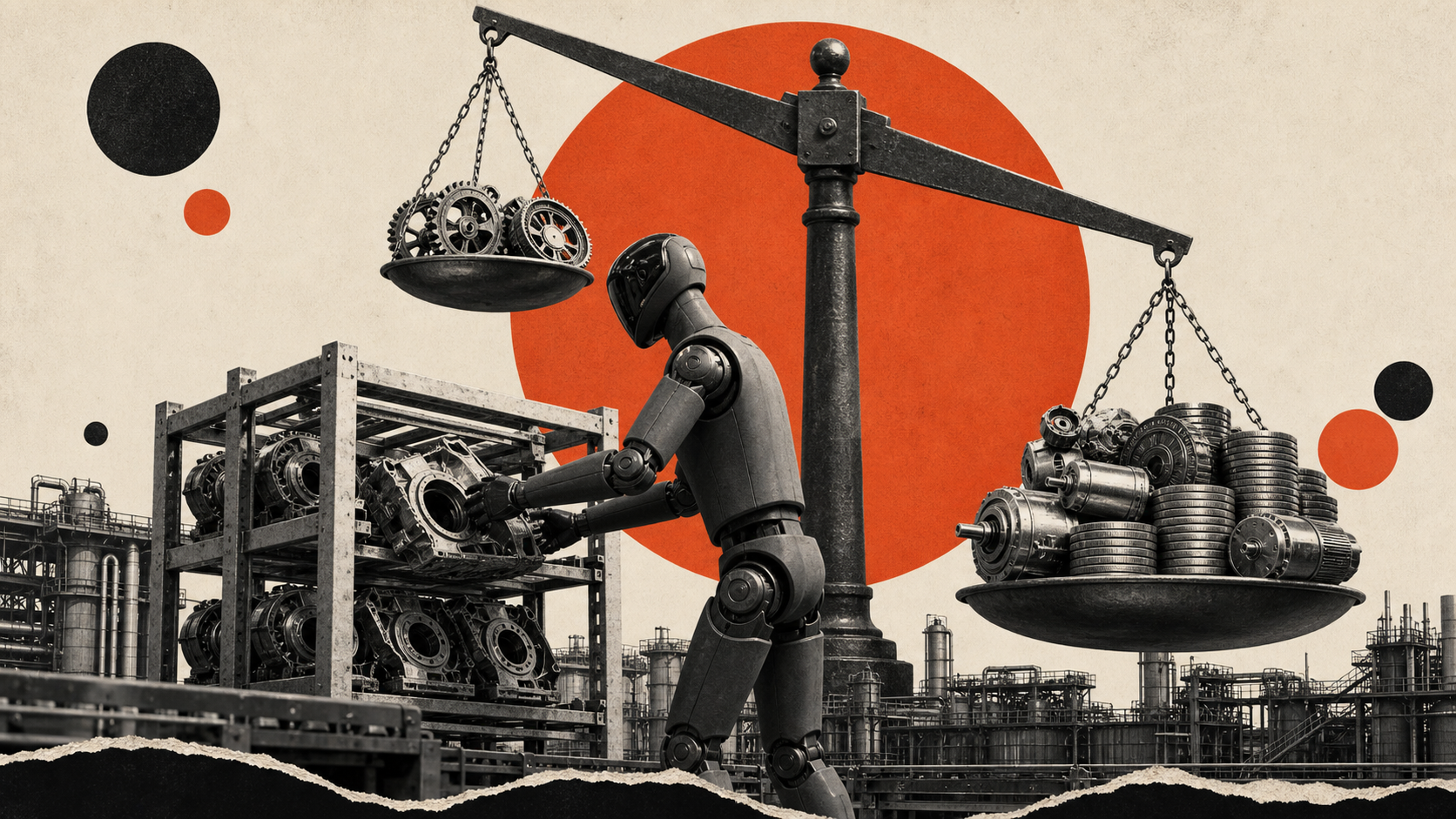
Humanoid robots are becoming technically capable, but hardware cost, throughput, supervision, financing, and manufacturing scale will determine commercial adoption.
Technical progress has moved humanoids closer to real industrial work, but high unit costs, limited throughput, and policy friction still constrain institutional deployment.
Humanoid robotics is moving from a capability question to a capital allocation test. The machines can perform an expanding range of industrial tasks, but widespread adoption will depend on whether their productivity can justify hardware, integration, supervision, maintenance, and financing costs.
The technology has progressed materially. Vision systems, manipulation models, actuators, and robotic hands now support work that remained largely experimental several years ago. Agility Robotics says its Digit platform has moved more than 100,000 totes in commercial operations and has secured deployments with Toyota Motor Manufacturing Canada, GXO, Schaeffler, Amazon, and Mercado Libre. Alt Bionics has also developed a robotic hand with six powered degrees of freedom, an 18 kilogram lifting capacity, and repeatability below one millimeter. These advances reduce technical uncertainty, but they do not remove the economic hurdle.
Human supervision remains part of the operating model. Direct teleoperation assigns almost continuous human attention to each machine, limiting the labor savings that automation is expected to produce. A more scalable structure places people in supervisory roles, allowing them to intervene only when a robot encounters an unusual object, workflow, or safety condition. Each intervention can improve future performance, but the required supervision still belongs in any realistic return calculation. Investors should treat autonomy rates and intervention frequency as financial metrics rather than technical footnotes.
Specialized automation continues to set the productivity benchmark. Leading humanoid parcel demonstrations operate near 1,000 to 1,200 items per hour under controlled conditions. Robominds advertises up to 1,800 parcels per hour for its dedicated Titan system, while Fortna reports peak throughput of up to 3,000 packages per hour for its dual robotic arm solution. A humanoid may eventually justify lower facility conversion costs and greater flexibility across multiple tasks, but a dedicated machine can deliver more output when a workflow is stable and volume is high. The relevant comparison is therefore total cost per completed task, not the sophistication of the robot.
Hardware cost is the immediate constraint. Agility Robotics disclosed an approximate bill of materials of $125,000 for the current Digit version, while earlier prototype costs were substantially higher. Its investor presentation projects further reductions through engineering changes, supplier development, component consolidation, and annual production volumes reaching thousands of units. Those projections remain illustrative. For manufacturers, the acquisition cost is only the starting point because deployment, software, maintenance, charging infrastructure, spare parts, and production downtime all affect the payback period. Higher interest rates raise the return threshold further by increasing the cost of financing industrial automation.
Manufacturing competence may become a larger competitive advantage than model intelligence. Tesla has experience scaling complex hardware, coordinating global suppliers, reducing component costs, and spreading engineering expenditure across large production runs. The company has told investors that it is preparing for large scale Optimus production, while its automotive manufacturing base provides an infrastructure advantage over research focused robotics firms. That advantage is credible, but leadership is not assured. Tesla must still demonstrate reliability, safety, service economics, and repeatable production for a machine whose components and operating requirements differ materially from those of an electric vehicle.
Industrial policy is reshaping the cost curve. The Federal Communications Commission has restricted new foreign made humanoid and quadruped robot models from entering the United States, citing cybersecurity and supply chain concerns. China accounted for an estimated 85% of the global humanoid market, according to Omdia data reported by the Associated Press, while Chinese manufacturers have generally scaled production and reduced prices more quickly than their United States peers. The restriction may protect domestic developers from low cost competition, but it can also increase acquisition costs, reduce research access, and slow price discovery for American manufacturers.
For allocators, the investable opportunity may initially sit around the robot rather than entirely within the robot developer. Actuators, precision motors, sensors, power systems, machine vision, semiconductors, warehouse integration, maintenance software, and fleet supervision can benefit as deployment expands across competing platforms. This supplier approach may provide broader exposure to automation spending while reducing dependence on a single humanoid design reaching commercial scale.
The decisive evidence will come from factory economics. Investors should monitor bill of materials reductions, production volume, uptime, intervention frequency, useful output per hour, maintenance expense, and customer renewal rates. Humanoids will become an institutional automation category when those measures produce competitive returns without relying on optimistic assumptions about future autonomy.