
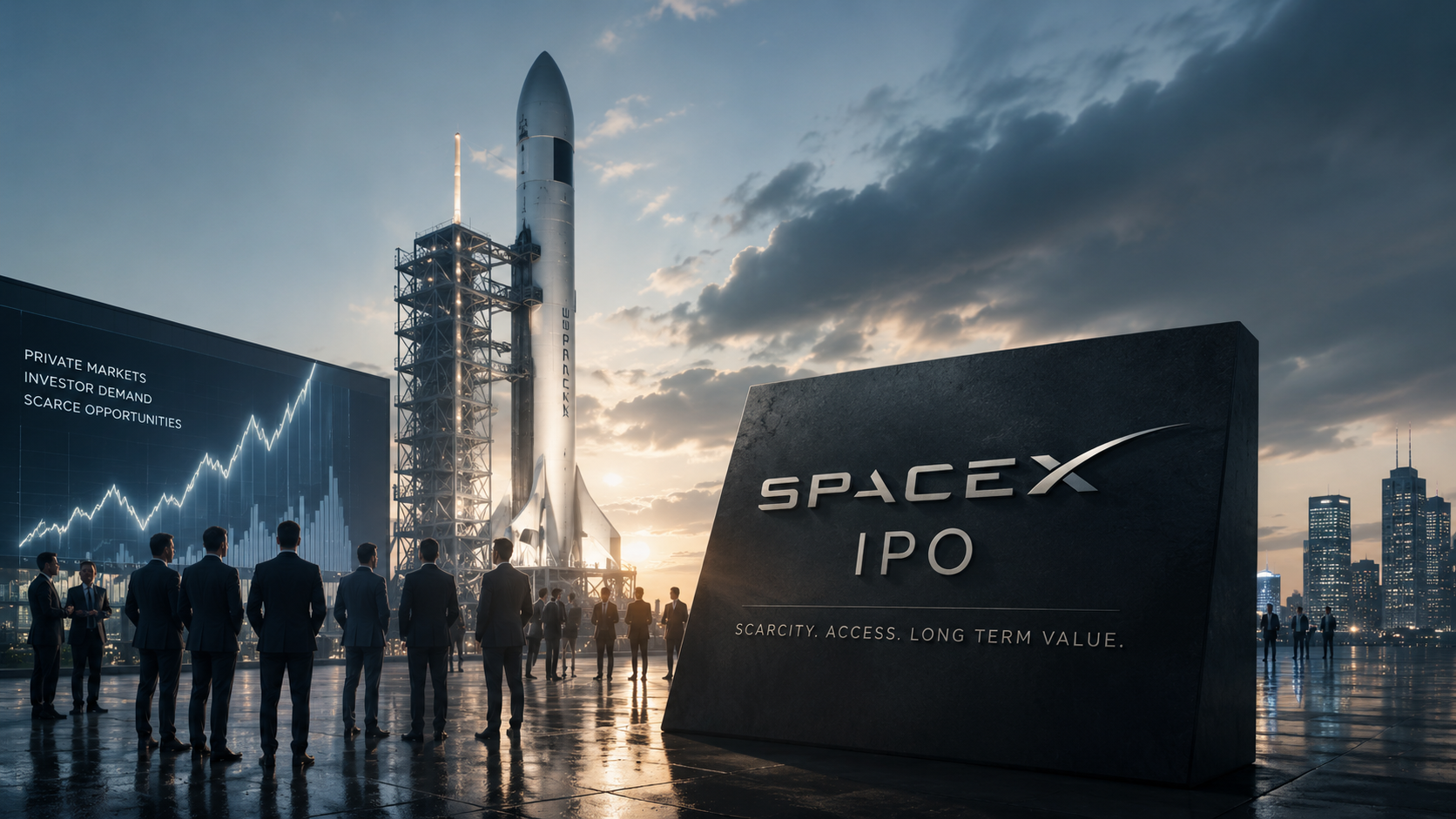
The record breaking SpaceX listing reflects investor appetite for scarce growth assets, but its valuation and market structure raise important questions for long term allocators.
Investor demand for SpaceX’s initial public offering has reached extraordinary levels. Orders have reportedly exceeded available shares by more than two times, making the listing one of the most sought after equity offerings in recent years. The enthusiasm reflects more than excitement around a single company. It highlights a broader trend in global capital markets as investors increasingly pursue access to a shrinking universe of transformative private companies that have remained outside public markets for longer than previous generations of technology leaders.
SpaceX enters the public market with a valuation approaching $1.75 trillion, immediately placing it among the largest listed companies in the world. Yet unlike many mega capitalization firms, the company remains unprofitable and continues to operate in highly capital intensive industries that require substantial ongoing investment. For allocators, this creates a familiar tension between exceptional growth potential and elevated execution risk. The valuation implies years of sustained expansion across launch services, satellite communications, defense contracts, artificial intelligence applications, and adjacent technologies, leaving limited room for operational disappointments.
The offering also represents an important shift in IPO market dynamics. Retail investors have been allocated an unusually large portion of available shares, a structure that is typically reserved for institutional buyers. Major brokerage platforms significantly lowered eligibility thresholds ahead of the transaction, expanding access to a broader investor base. While democratized participation may increase market engagement, it also introduces the potential for greater short term volatility as a large number of investors attempt to gain exposure to a highly anticipated listing simultaneously.
The enthusiasm surrounding SpaceX should also be viewed within the context of private market scarcity. Over the past decade, many of the world’s most valuable technology companies have delayed public listings while raising capital privately at increasingly higher valuations. This dynamic has concentrated value creation within venture capital and private equity ecosystems, leaving public market investors with fewer opportunities to participate in early growth stages. The intense demand for SpaceX shares suggests investors are willing to pay a premium simply to access a company that has historically remained beyond the reach of most portfolios.
For portfolio managers, the critical question is whether the investment case justifies the valuation. At roughly 110 times trailing revenue, SpaceX trades on future expectations rather than current financial performance. The company faces operational risks associated with launch schedules, satellite deployments, regulatory approvals, government contracts, and competitive pressures across both aerospace and communications markets. Future public offerings from high profile artificial intelligence companies such as Anthropic and OpenAI could also divert investor attention and capital toward alternative growth opportunities.
The listing carries broader implications for index construction and passive investing. Although SpaceX is expected to gain rapid inclusion within major technology benchmarks, it is unlikely to qualify for the S&P 500 in the near term due to profitability requirements. This distinction matters because passive flows have become one of the most powerful drivers of equity performance over the past decade. Without immediate access to the largest benchmark driven capital pools, the company’s share price may remain more sensitive to active investor sentiment and earnings expectations.
For allocators, the SpaceX IPO serves as both an opportunity and a cautionary signal. It demonstrates the enormous demand for exposure to category defining private businesses while underscoring the valuation risks that emerge when scarcity meets investor enthusiasm. The success of the offering may ultimately be less important than what it reveals about market psychology. Capital continues to gravitate toward a small group of perceived winners in artificial intelligence, space infrastructure, and advanced technology. Whether those expectations prove justified will shape the next phase of growth investing across both public and private markets.